
RFID PRODUCT SELECTION GUIDE
RFID-E-001 Closed-Hole Electronic Ear Tag: Choosing LF, HF or UHF
For livestock-identification companies, RFID integrators, distributors, sourcing teams, and engineers

RFID-E-001 is a passive closed-hole ear tag platform that can be configured for LF, HF or UHF identification systems.
Selecting RFID electronic ear tags is not only a question of size, color or quoted read distance. The tag, chip, protocol, reader, data format, male stud and approval route must work as one system. A tag that performs well with one reader population may be unsuitable for another, and a protocol reference alone does not make a device officially approved in every market.
Sensync RFID-E-001 is a closed-hole, button-style electronic ear tag designed as a configurable platform. According to the supplied product data, it can be built with LF, HF or UHF RFID options, including read-only EMID, ISO 11784/11785-oriented FDX-B and HDX variants, HF/NFC options and an EPC Gen2 UHF option.
This guide explains the practical differences, the limits of headline read-range figures, and the information buyers should confirm before approving samples or production.
The Short Answer: Select the System Before the Tag
Use the existing reader infrastructure and data requirements as the starting point:
- Choose FDX-B or HDX at 134.2 kHz when the project is built around ISO 11784/11785 animal-identification architecture and compatible LF readers.
- Choose 125 kHz EMID when a simple factory-programmed read-only identifier and matching EMID reader infrastructure are required.
- Choose 13.56 MHz ICODE SLIX for ISO 15693 HF workflows that need read/write memory and compatible HF readers.
- Choose 13.56 MHz NTAG216 for short-range NFC/ISO 14443 Type A interaction, including applications designed around compatible NFC devices.
- Choose Higgs-4 UHF for EPC Gen2/ISO 18000-6C systems that prioritize longer-range reading and can be configured for the destination market’s permitted UHF band.
The supplied manual lists reference ranges from a few centimeters up to 2.5 meters, depending on the variant. Treat these as configuration references, not guarantees. Reader power, antenna geometry, tag orientation, attachment, nearby materials, regional limits and the operating environment all affect the result.
What Is a Closed-Hole RFID Electronic Ear Tag?
A closed-hole electronic ear tag is the female component of a two-part ear-tag assembly. The male stud passes through the animal’s ear and locks into the central interface of the electronic tag. In RFID-E-001, the electronic antenna and IC are enclosed inside a circular housing rather than exposed at the attachment point.

The closed-hole female tag contains the RFID assembly inside a compact button-style housing.
The RFID-E-001 source data describes the following nominal physical construction:
- Product size: 30 mm diameter x 14.6 mm.
- Nominal dimensional tolerance: +/-0.3 mm.
- Approximate weight: 7 g.
- Internal frame: modified nylon.
- Outer housing: TPU (thermoplastic polyurethane).
- Encapsulation: secondary injection molding / integrated overmolding.
- Inner frame color: black.
- Outer housing colors: yellow, red, pink, green or blue.
- Ingress protection: IP67, based on the supplied product manual.
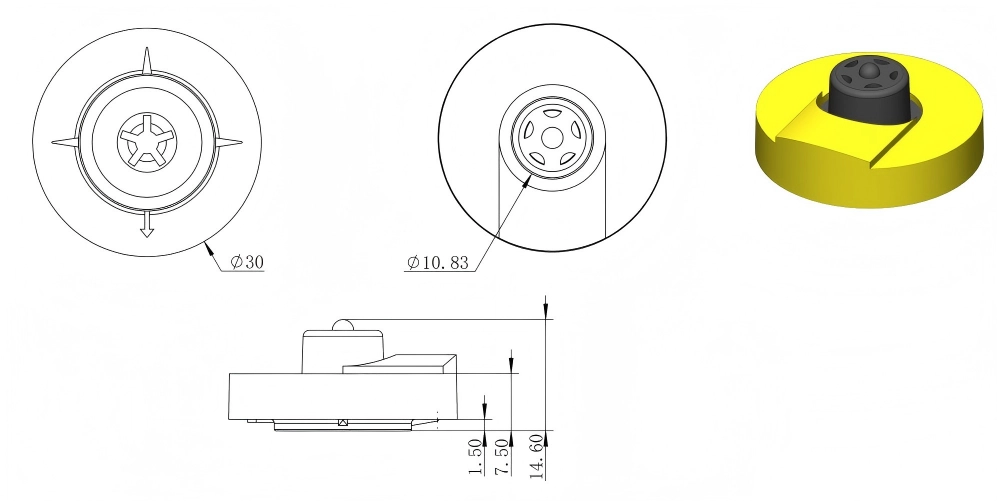
Nominal dimensions are 30 mm in diameter and 14.6 mm in height; approved samples and final order drawings should govern acceptance.
Dimensions, colors, mold geometry and internal details may change with the confirmed configuration. For production projects, the approved physical sample and order-specific drawing should take precedence over a general brochure.
How the Layered Construction Protects the RFID Assembly
The supplied construction drawings show four functional elements: an outer TPU housing, two internal frame parts, and an inductive antenna plus RFID IC assembly. The frame locates the electronic assembly, while the overmolded housing encloses the internal parts and forms the external tag body.

The antenna and RFID IC assembly are positioned between the internal frame components before the outer housing is formed.
This architecture matters because field performance depends on more than the chip name. Antenna position, connection quality, molding pressure, material interaction and dimensional consistency can all influence the completed transponder. Qualification should therefore include the finished ear tag, not only the bare IC or antenna subassembly.

The cross-section illustrates how the closed-hole interface and RFID assembly are enclosed inside the overmolded structure.
The product manual also lists an operating range of -20 degrees C to +65 degrees C during communication and a storage range of -30 degrees C to +75 degrees C under non-condensing, non-icing conditions. It records a +100 degrees C hot-water condition for one hour over 20 cycles. These are source-manual conditions; buyers should request the applicable test report and agree on their own validation plan for regulated, safety-critical or unusually harsh applications.
RFID-E-001 Frequency and Chip Options
EMID: 125 kHz Read-Only Identification
RFID-E-001-EMID uses an EM4200-family chip and a factory-programmed read-only identifier. The supplied manual lists 125 kHz operation, ISO 18000-2/EMID protocol reference and a nominal range of 1 to 50 cm.
This option fits systems that need a straightforward identifier and already use compatible 125 kHz readers. Because it is read-only, it is not the right choice when the tag must store project-specific data after production.
FDX-B: 134.2 kHz ISO Animal-Identification Architecture
RFID-E-001-FDX uses an EM4305 chip with read/write EEPROM. The product data lists 134.2 kHz operation, ISO 11784/11785 FDX-B, 512 bits of EEPROM with 288 bits of user data, and a reference range of 1 to 55 cm.
FDX-B is a common starting point when livestock identification must operate with compatible ISO-based LF readers. The identifier format, code allocation, approval process and data programming still need to be confirmed for the target market and program.
HDX: 134.2 kHz for Compatible HDX Reader Systems
RFID-E-001-HDX uses the SIC279 chip and is listed with read/write capability, 528-bit organization, 192 bits of extended user memory and a nominal 1 to 60 cm range. It references ISO 11784/11785 HDX operation.
Choose HDX only when the intended readers and livestock-management system support it. FDX-B and HDX share a 134.2 kHz context but use different communication behavior; they should not be treated as interchangeable labels.
ICODE SLIX: 13.56 MHz ISO 15693 HF
The SLIX configuration uses an NXP ICODE family chip. The source data lists 1,024 bits of EEPROM, 896 bits of user data, a globally unique 64-bit read-only UID and a reference range of 1 to 15 cm.
This variant suits HF identification systems designed around ISO 15693 and compatible readers. It is not an ISO 11784/11785 livestock transponder merely because it is installed in an animal ear-tag housing.
NTAG216: 13.56 MHz NFC / ISO 14443 Type A
The NTAG216 option provides a 7-byte UID and 924 bytes of EEPROM, including 888 bytes of user memory, according to the supplied product data. Its nominal range is 0.1 to 3 cm.
It is appropriate for short-range interactions with compatible NFC or ISO 14443 Type A devices. A smartphone-oriented workflow can be useful for local access to tag-linked information, but phone compatibility, application behavior, authentication and data security must be validated separately.
Higgs-4: EPC Gen2 UHF
The H4 configuration uses Alien Higgs-4 and references EPC Class 1 Gen 2 / ISO 18000-6C. The product data lists a 96-bit EPC encoding, user and TID memory banks, and a nominal 1 to 2.5 m range.
UHF can support longer-distance and faster operational workflows, but it is more sensitive to orientation, reader antenna layout, surrounding materials and local radio rules. The manual’s 920 MHz figure is nominal; the tag and reader system must be configured for the permitted frequency band and power limits in the destination market.
Why Published Read Range Is Only a Reference
Read range is a system result, not a fixed property of the plastic tag. Before comparing two samples, control at least the following:
- Reader model, firmware and output power.
- Reader antenna type, polarization and placement.
- Tag orientation and movement through the read zone.
- Whether the tag is tested in air, on a male stud or installed on an animal.
- Nearby metal, water-rich tissue, fencing, gates and other tags.
- Data rate, anti-collision settings and acceptable missed-read rate.
- Regional frequency and power restrictions.
- Test distance, sample size and pass/fail definition.
For engineering approval, record the complete setup and compare a distribution of results across multiple samples. A single best-case distance is not a reliable incoming-inspection specification.
Matching Male Studs and Installation Hardware
RFID-E-001 is designed to work with a compatible male stud and applicator. The supplied data identifies three nominal stud options:
- EG-001: 30 mm disc with a 25 mm stud; the default matched male tag.
- EG-002: 56 x 38 mm panel with a 26 mm stud for a larger visual-marking area.
- EG-003: 64 x 72 mm panel with a 24 mm stud for extended visual identification.

Male-stud geometry, applicator compatibility and the intended livestock species should be confirmed before production.
Do not select the stud only from its overall length. The mating geometry, material, point shape, ear thickness and applicator jaws all influence installation. Confirm the complete tag-and-stud assembly with representative animals and the farm’s hygiene procedure.

Use a compatible applicator and follow species-appropriate placement and hygiene procedures.
Standards, Official Identification and Market Approval
ISO 11784:2024 specifies the animal RFID code structure, while ISO 11785:2026 specifies transponder activation and information transfer. ISO 24631-1:2025 addresses conformance evaluation, including manufacturer-code considerations, and ISO 24631-3:2025 addresses transponder performance evaluation.
These references apply most directly to the relevant LF animal-identification variants. They do not automatically cover every HF or UHF configuration in the same housing.
Protocol compatibility is also different from government or program approval. For example, USDA APHIS maintains approved device listings and market-specific requirements for official identification. Its 2024 rule concerns electronically and visually readable official ear tags for the interstate movement of certain cattle and bison, not every animal in every situation. RFID-E-001 should not be described as an official device for a country or program unless the exact configuration has completed that approval path.
A Practical Pre-Production Checklist
Before approving an RFID electronic ear tag order, confirm:
- Target species, ear thickness and installation procedure.
- Required RFID band, chip, protocol and memory architecture.
- Identifier format, programming responsibility and data-locking rules.
- Existing reader models, antennas, firmware and software integration.
- Target market, radio-frequency rules and official-device approval route.
- Tag color, laser marking, visual number and barcode requirements.
- Male-stud option and applicator compatibility.
- Mechanical drawing, approved sample and acceptance tolerances.
- Environmental, ingress, chemical, pull, impact and aging tests.
- Packaging, lot traceability, inspection report and change-control process.
The most useful sample approval combines physical inspection, programming verification and controlled read testing with the intended reader population.
Discuss an RFID-E-001 Configuration With Sensync
Sensync supports RFID and NFC component development, winding equipment and animal-identification products. For background on the antenna inside a passive tag, see our RFID coils for animal ear tags guide. Related component capabilities are described on the custom electronic coils page, while RFID glass microchips provide another physical format for animal identification.
For RFID-E-001, send the Sensync team your target band, chip or protocol, reader information, species, visual-marking format, stud preference, destination market and expected quantity. The engineering review should confirm the exact configuration before sample production.
Frequently Asked Questions
Is RFID-E-001 an LF, HF or UHF ear tag?
It is a configurable housing platform. The supplied product data lists LF EMID, FDX-B and HDX options; HF ICODE SLIX and NTAG216 options; and a Higgs-4 UHF option. The ordered configuration determines the frequency, protocol, memory and reader compatibility.
Which RFID option is best for livestock identification?
There is no universal choice. FDX-B or HDX at 134.2 kHz is the starting point for many ISO 11784/11785 animal-identification systems. EMID, HF/NFC or UHF may be appropriate when the reader infrastructure and workflow are designed for those technologies.
Is the quoted read range guaranteed?
No. The figures in the product manual are reference ranges. Actual performance depends on the reader, antenna, output power, tag orientation, installation, surrounding materials, local regulations and test method.
Does ISO 11784/11785 compatibility make the tag officially approved?
No. Technical compatibility and official device approval are separate. Confirm the applicable conformance testing, manufacturer or country code, device listing and program rules for each destination market.
Can the ear tag be read with a smartphone?
Only configurations and phones that share a compatible HF/NFC protocol can interact directly. The NTAG216 variant is the relevant short-range NFC option in the supplied data. LF FDX-B/HDX and UHF variants normally require dedicated compatible readers.
What should be sent with an RFQ?
Provide the target species and market, required chip/protocol, reader models, visual marking and encoding format, male-stud preference, environmental tests, packaging, expected quantities and any existing sample or approval requirements.
References
- ISO 11784:2024 – Radio frequency identification of animals: Code structure
- ISO 11785:2026 – Radio frequency identification of animals: Technical concept
- ISO 24631-1:2025 – Evaluation of transponder conformance
- ISO 24631-3:2025 – Evaluation of transponder performance
- USDA APHIS animal disease traceability overview


