
In the mass production of air-core coils, wireless charging coils, RFID antenna coils, and motor stator or rotor windings, the winding machine you choose directly determines coil consistency, production yield, and per-unit cost.
With options ranging from single-spindle machines and multi-wire parallel winders to 4-axis brushed rotor machines, 6-axis brushless stator machines, and integrated winding-soldering systems, procurement and engineering teams often struggle to know where to start.
This guide covers the 6 key parameters to evaluate when selecting a fully automatic winding machine — along with a quick-reference selection table by application — to help you translate your production requirements into a reliable manufacturing solution.
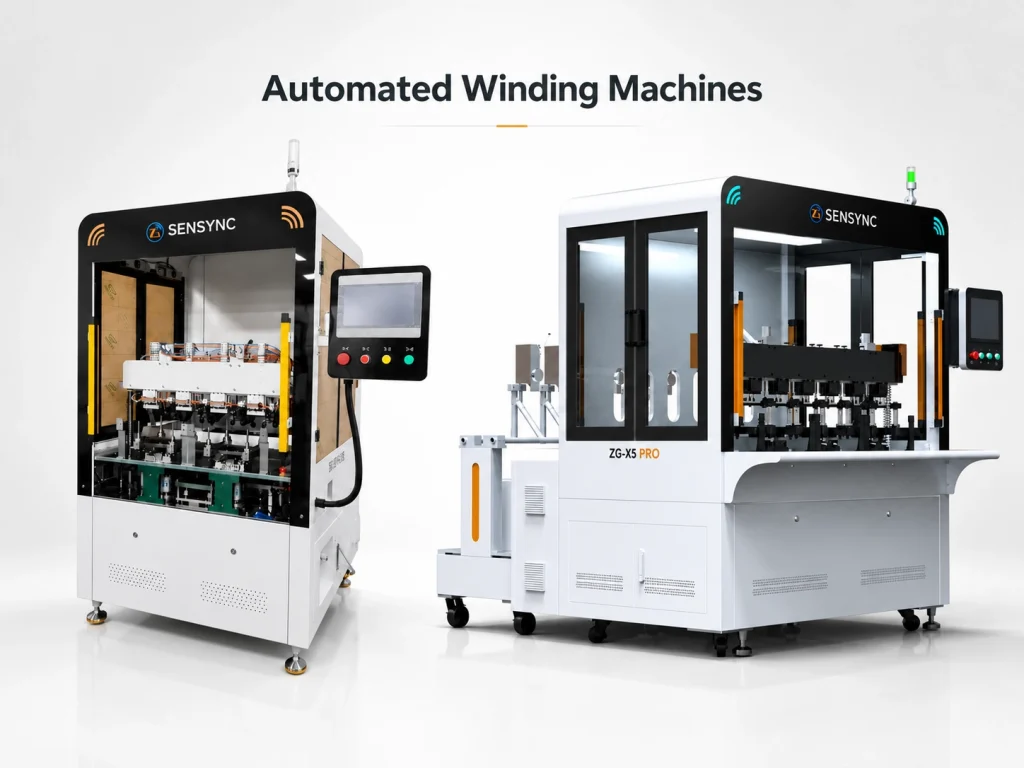
1. Winding Precision and Repeatability
A coil’s electrical performance — inductance, Q factor, and batch-to-batch consistency — is highly dependent on how accurately and consistently the wire is laid.
Three things to look at:
- Repeat positioning accuracy: High-end machines can achieve ±0.001mm (as seen in Alpha winding machines for wireless charging coils). For frequency-sensitive or high-consistency applications, this level of control is not optional.
- Wire arrangement method: Servo-controlled wire traversal offers more flexibility and faster changeover than mechanical cam systems. It also handles irregular winding profiles more reliably.
- Tension control: A constant-tension system is essential for fine wire diameters and high-yield production. Inconsistent tension is one of the most common causes of coil resistance variation and turn count drift.
Recommendation: For wireless charging, RFID, and other precision-sensitive coil types, prioritize machines with servo-driven wire traversal and active tension control.

2. Number of Axes and Structural Compatibility
Different coil products require different winding structures. Choosing the wrong machine type limits both output and yield:
- Single-Spindle Winding Machine — Suitable for air-core coils, samples, and low-to-medium volume runs. Flexible and easy to set up for multiple coil types.
- Multi-Wire Winding Machine — Winds multiple wires in parallel, significantly increasing output per cycle. Suitable for coil types requiring multi-strand or parallel winding.
- 4-Axis Brushed Motor Rotor Winding Machine — Designed for outer rotor batch production. Combines four-axis synchronous winding with automatic position shifting and wire arrangement.
- 6-Axis Brushless Motor Stator Winding Machine — Six simultaneous winding stations for high-volume brushless motor stator production, suitable for drone motors, automotive applications, and power tools.
- Integrated Winding, Soldering & Chip Bonding Machine — Combines winding, soldering, and inspection in a single continuous process, reducing manual handoff between stages.
Matching the machine type to your coil structure is the single most important decision in the selection process.

3. Drive System and Control Architecture
- CNC precision control with servo drive: Provides stable, repeatable results. Changeover between coil types is handled through program recall rather than mechanical adjustment.
- Delta servo systems: High dynamic response, particularly suited to Alpha winding machines for wireless charging coils where precise angular control at high speed is required.
- Parameterized programming and one-touch changeover: Essential for facilities running multiple product types or short production runs. If changeover requires significant mechanical re-setup, multi-product flexibility becomes impractical.
When evaluating control systems, ask the supplier for a demonstration of changeover time between two different coil programs — not just a specification sheet.
4. Output Capacity and Automation Integration
The real cost advantage in coil production comes from integrating winding, soldering, testing, and material handling into a continuous process — not from maximizing the speed of any single machine.
Key considerations:
- Automatic loading and unloading: Reduces operator dependency and eliminates manual transfer time between cycles.
- Inline inspection (vision or electrical): Real-time defect detection allows immediate rejection and prevents downstream processing of non-conforming coils.
- MES and production line compatibility: Can the machine communicate with your existing manufacturing execution system or feed data to downstream stations?
When comparing machines, evaluate overall line throughput and operator headcount requirement — not just individual machine cycle time.

5. Wire Diameter Range and Coil Type Compatibility
Confirm that the machine covers your required wire diameter range (for example, 0.02–0.5mm) and the coil types you produce:
- Air-core inductor coils
- Wireless charging coils (TX/RX)
- RFID and NFC sensing coils
- Motor stator and rotor windings
If your facility produces multiple coil types across different projects, prioritize platform-based machines with fast, program-driven changeover — rather than dedicated single-product machines that require mechanical modification to switch between products.

6. Quality Control and Production Traceability
A winding machine’s mechanical precision means little if the surrounding quality system cannot detect, record, and respond to variation. Look for:
- Full-process quality coverage: Incoming material inspection, in-process control, and final inspection — not just end-of-line testing.
- Production traceability: Batch records, process parameters, and yield data should be retrievable for each production run. This is a basic requirement for automotive electronics, medical, and other regulated supply chains.
- Demonstrated yield rate: Under mature process conditions, well-controlled winding operations should consistently achieve yield rates of 99.9% or above.
ISO 9001 certification is a baseline indicator of a structured quality management system, but the more meaningful question is whether the manufacturer can show you actual process data — not just a certificate.
Quick Selection Reference by Application
| Application | Recommended Machine | Key Requirements |
| Wireless Charging Coils | Alpha Winding Machine | ±0.001mm precision, Delta servo |
| Brushless Motor Stators | 6-Axis Stator Winding Machine | Six-axis synchronous winding, auto positioning |
| Brushed Motor Rotors | 4-Axis Rotor Winding Machine | Auto position shifting, wire arrangement |
| RFID / NFC / Air-Core Coils | Single-Spindle or Integrated Machine | Flexibility, process integration |
| Multi-Wire Parallel Coils | Multi-Wire Winding Machine | Parallel winding, high output |
| Mixed Product / Small Batch | CNC Parameterized Platform | Fast changeover, program-based setup |
Why Work with Sensync
Founded in 2001, Dongguan Sensync Technology Ltd. integrates R&D, design, production, and sales under one roof. Our winding machines have been qualified for Apple’s supply chain, and our manufacturing operations are certified under ISO 9001.
We offer OEM and ODM development based on customer drawings, samples, or production requirements, and support the full project lifecycle from prototype through stable volume production. Our machine range covers single-spindle, multi-wire, 4-axis brushed rotor, 6-axis brushless stator, integrated winding-soldering, and Alpha wireless charging coil winding machines — alongside custom electronic coils and RFID glass microchips.
Frequently Asked Questions
Q1: How do I choose between a single-spindle machine and a 4-axis or 6-axis machine?
It depends on your production volume and coil structure. For samples, small batches, or air-core coils, a single-spindle machine offers the most flexibility. For high-volume production of outer rotor or stator windings, a 4-axis or 6-axis automatic machine will deliver better output consistency and lower per-unit labor cost.
Q2: Can a winding machine be used to produce custom coils as well as standard products?
Yes. We support OEM and ODM development based on drawings, samples, or application requirements — covering wireless charging coils, RFID and NFC sensing coils, air-core inductors, and motor windings.
Q3: How long does changeover take between different coil types?
On CNC parameterized machines, changeover between products is handled by recalling the corresponding program — typically measured in minutes rather than hours. This makes these platforms well-suited for facilities running multiple coil types across different projects.
Q4: What is the minimum order quantity for a winding machine or custom coil project?
Projects can start from a small number of samples. As production requirements grow, output can be scaled up without re-qualifying a new supplier or changing the production setup.
Have a Specific Project in Mind?
Send us your application requirements and production parameters. Our engineering team will come back with a practical manufacturing recommendation — whether you need a machine evaluation, a coil development project, or a volume production solution.


