
Product-level identification is moving deeper into manufacturing, logistics, access control, consumer electronics and connected devices. For manufacturers of RFID, NFC, smart-card and sensing components, that growth creates a practical production challenge: how can fine-wire coils be wound, positioned, connected and inspected consistently at commercial volumes?
The difficulty is rarely the winding operation alone. A production line may also need wire arrangement, chip or terminal feeding, high-frequency soldering, waste-wire cutting, inspection and transfer. When these operations are separated across multiple machines or manual workstations, every handover adds another opportunity for positioning error, coil deformation, inconsistent solder joints and lost cycle time.
An integrated RFID coil winding machine addresses this problem by organizing the required operations into one coordinated production platform. This guide explains where integration creates value, what manufacturers should evaluate and where an automated winding-and-soldering system fits within the wider RFID/NFC production process.
Important scope note: This article focuses on wound coils and related electronic assemblies. Printing, web converting, lamination, encoding and die-cutting of complete smart labels are separate production processes and may require additional equipment.

A multi-station platform for continuous winding, soldering, inspection and transfer.
Why RFID/NFC Coil Production Matters in 2026
Demand for reliable product identification and traceability continues to broaden. The RAIN Alliance reported that four leading member chip manufacturers shipped 42.7 billion RAIN RFID tag chips in 2025. Although the total was below the exceptional 2024 level, the organization reported approximately 50% market growth over four years and continued expansion in retail, logistics, manufacturing, healthcare, food and consumer electronics.
At the same time, the European Commission launched the Digital Product Passport Registry on July 20, 2026. The system supports unique product identifiers and interoperable product information for categories covered by the Ecodesign for Sustainable Products Regulation and other EU legislation.
These developments show the growing importance of item-level identity and reliable data carriers. They should not, however, be interpreted as a universal requirement for wound RFID coils. A Digital Product Passport can use different data-carrier technologies, and many UHF RAIN RFID tags use etched or printed antennas rather than wound coils.
The opportunity for coil manufacturers is more specific. Wound antennas and sensing coils remain relevant in NFC, HF and LF identification, smart cards, access-control modules, IoT sensors, consumer electronics and selected automotive applications. In these products, production consistency depends on precise handling of fine enameled wire and stable coordination between winding and downstream connection processes.
Where Conventional Coil Production Becomes a Bottleneck
A segmented line can produce acceptable components, but its hidden costs become more visible as volume and quality requirements rise.
Repeated positioning between processes
If a coil is wound on one station and manually loaded into another fixture for soldering, its position must be established again. Repeated loading and unloading may introduce variation, particularly with small or flexible fine-wire coils.
Manual transfer and work-in-process
Separate machines create buffers between operations. Components wait in trays, operators move them between workstations and production teams must track partially completed parts. These activities do not add value to the product but consume labor, floor space and management attention.
Uneven cycle times
Winding, feeding, soldering and inspection may operate at different speeds. Without coordinated station timing, one process can become a bottleneck while another machine remains idle.
Fine-wire handling risk
Thin enameled wire requires controlled tension, accurate routing and stable tooling. Excessive handling can lead to displaced turns, damaged insulation, broken leads or inconsistent terminal positioning.
Batch-to-batch variation
When production depends heavily on operator judgment, process results may change across shifts. Automated parameter control cannot eliminate every source of variation, but it helps make the operating sequence more repeatable.
What an Integrated Coil Production Platform Changes
Sensync’s ZG-CPWM100 combines multiple operations in a cam-indexer-driven, multi-station structure. Depending on the product and customized tooling, the production sequence can include:
- Wire feeding — supplies enameled wire to the winding station.
- Coil winding — forms the specified coil geometry and number of turns.
- Wire arrangement — controls lead position for the next operation.
- Chip or component feeding — presents the required component to the assembly station.
- High-frequency soldering — connects the coil leads to the relevant contact points.
- Waste-wire cutting — removes excess wire after connection.
- Finished-product inspection — checks defined product or process conditions.
- Automatic transfer — moves completed assemblies out of the processing sequence.

Illustrative process sequence. The final station arrangement and inspection functions depend on the product and confirmed project requirements.
Instead of treating each operation as an isolated task, the platform coordinates them as one continuous manufacturing process. This changes the role of automation from simply increasing winding speed to improving the flow and repeatability of the complete coil assembly sequence.
Four Production Advantages of Integration
1. Fewer process handovers
Keeping the component within a coordinated multi-station system reduces manual movement between winding, soldering and inspection. Fewer handovers can help protect coil geometry and lead positioning while simplifying material flow.
2. Consistent station timing
The eight synchronized stations work within a common production rhythm. Coordinated timing helps manufacturers plan output more clearly and identify where a product-specific operation may require optimization.
3. Controlled positioning and recipe management
High-resolution servo drives provide controlled motion and positioning, while PLC control and a touchscreen HMI allow operators to set and adjust process parameters. Stored or standardized settings can also make training and product changeovers more manageable.
4. Adaptability through fixtures and tooling
RFID, NFC and sensing coils vary in diameter, shape, lead configuration, terminal design and number of turns. Replaceable fixtures and molds allow an integrated platform to be engineered around different product structures without implying that one universal setup can manufacture every coil.
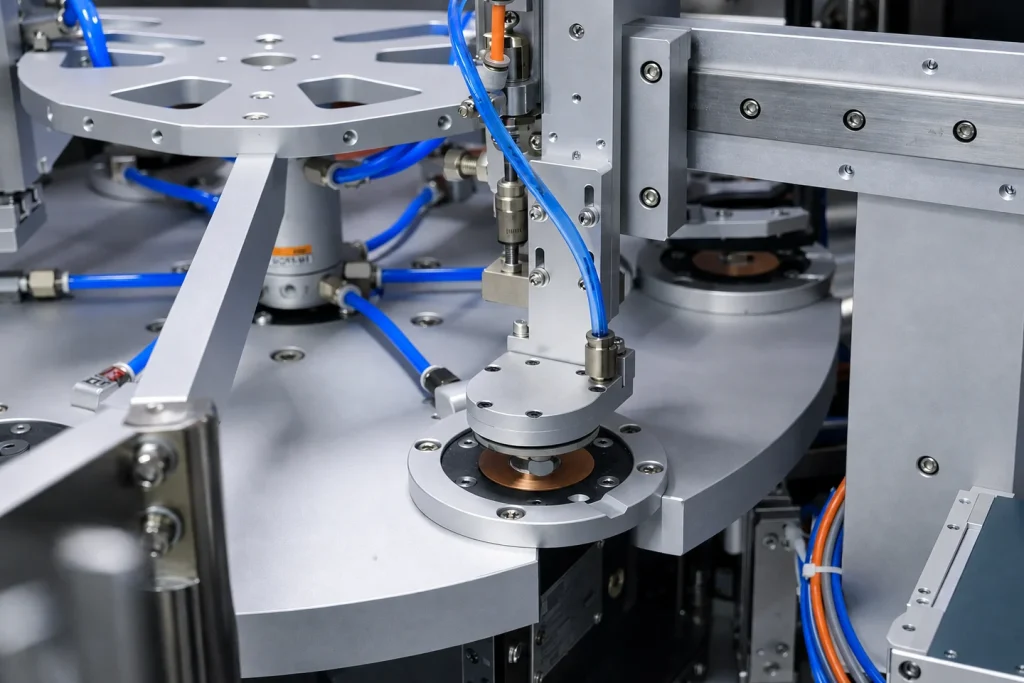
Real internal view of the rotary processing platform and coil fixture.
Key Technical Capabilities to Evaluate
The following specifications describe the standard ZG-CPWM100 configuration. Final performance should always be confirmed against the customer’s product drawing, samples and process requirements.
| Item | Standard configuration | Why it matters |
| Number of axes/stations | 8 axes / 8 synchronized stations | Supports coordinated multi-process production |
| Wire diameter range | Φ0.04–Φ0.25 mm | Covers a range of precision enameled-wire products |
| Maximum product outer diameter | Φ80 mm | Defines the standard product envelope |
| Nominal capacity | 500–550 pcs/h | Actual output depends on coil turns and process complexity |
| Control system | PLC servo control + touchscreen HMI | Supports parameter adjustment and coordinated motion |
| Mechanical structure | Cam indexer multi-station structure | Provides repeatable indexing between processing positions |
| Power input | AC 220 V ±10%, 50 Hz | Important for factory utility planning |
| Power consumption | 7 kW | Supports electrical capacity planning |
| Machine dimensions | L1250 × W1150 × H1900 mm | Supports layout and access planning |
| Machine weight | Approximately 1100 kg | Relevant to transport, flooring and installation |
The headline capacity should never be evaluated in isolation. A coil with more turns, a complex lead arrangement or additional inspection requirements may need a longer cycle. For a useful quotation, suppliers should calculate capacity using the actual product rather than a generic maximum-speed claim.
Typical Products for Automated Winding and Soldering
An integrated fine-wire platform may be evaluated for:
- RFID electronic tag coils;
- NFC and access-control antennas;
- smart-card antenna coils;
- IoT sensing coils;
- reader and communication-module coils;
- consumer-electronics sensing coils;
- wireless charging coils within the confirmed machine envelope;
- selected automotive sensing, relay or communication-module coils.

Representative real coil samples. Geometry, wire size, terminals and process configuration vary by project.
Suitability depends on more than the application name. Two coils used in the same industry may require completely different winding paths, terminal designs, soldering methods and inspection criteria. A technical review should therefore begin with the component itself.
What to Prepare Before Requesting a Machine Proposal
Providing complete technical information at the beginning of a project reduces unnecessary assumptions and shortens the evaluation process. Manufacturers should prepare:
- A 2D or 3D product drawing;
- Finished-coil outer and inner dimensions;
- Wire material and diameter;
- Required number of turns and winding direction;
- Coil resistance, inductance or other inspection criteria;
- Lead length and wire-arrangement requirements;
- Chip, terminal or carrier specifications;
- Soldering method and joint acceptance criteria;
- Target production output;
- Existing samples, photos or process videos;
- Required traceability, data collection or factory-interface functions;
- Planned product variants and changeover requirements.
This information allows the equipment supplier to evaluate tooling, feeding, soldering, inspection and unloading as one process rather than quoting only the winding station.
Frequently Asked Questions
What is an RFID coil winding machine?
It is an automated system used to form enameled wire into a specified coil or antenna geometry for RFID, NFC, sensing or related electronic applications. Depending on the configuration, it may also include component feeding, soldering, cutting, inspection and unloading.
Can winding and soldering be integrated into one machine?
Yes. A multi-station design can coordinate winding, wire arrangement, component feeding, soldering, cutting, inspection and transfer. The precise sequence and tooling must be engineered around the product.
What wire sizes can the ZG-CPWM100 process?
The standard specified range is Φ0.04–Φ0.25 mm enameled wire. Final suitability depends on the wire material, insulation, tension requirements and coil geometry.
How is machine capacity calculated?
The standard reference output is 500–550 pieces per hour, but actual capacity depends on the number of turns, winding path, feeding method, soldering cycle and inspection requirements. A sample-based cycle evaluation is more reliable than a general speed figure.
Can the machine manufacture a complete RFID smart label?
Not by itself. The machine is designed for wound coils and related electronic assemblies. Complete smart-label manufacturing may also require antenna or inlay processes, printing, web handling, lamination, encoding, inspection and die-cutting equipment.
Can the equipment be customized?
Fixtures, molds, feeding mechanisms and selected process functions can be developed according to the customer’s product. Customization should be confirmed through a technical review and sample evaluation.
From a Coil Drawing to a Production-Ready Solution
For RFID, NFC and precision sensing components, the strongest automation result usually comes from engineering the complete process rather than purchasing a high-speed winding spindle in isolation. The winding pattern, lead handling, component feeding, soldering, inspection and unloading method must work together.
Sensync’s integrated winding, soldering and chip-bonding platform is designed for manufacturers that want to reduce manual handovers and build a more consistent multi-process workflow. Its eight synchronized stations, servo-driven positioning and PLC/HMI control provide a practical foundation for medium- to high-volume fine-wire production.
Planning a new coil project? Send Sensync your product drawing, wire specification, sample images and target output. The engineering team can evaluate the required winding, tooling, feeding, soldering, inspection and transfer configuration before preparing a technical proposal.
Request a technical evaluation:
Automatic Coil Winding, Soldering & Chip Bonding Machine
Email: info@sensynctech.com


